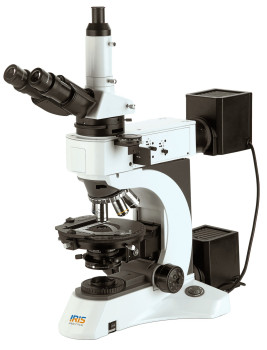
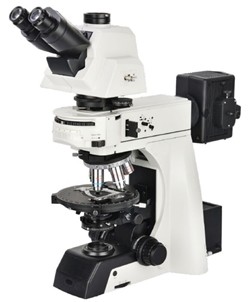
Polarizing Microscope IMP-2000 Series equipped with a high degree of sensitivity and best suited for anisotropic (mineral) specimens such as geology, minerals, metallurgy, university teaching laboratories, and other sectors. Built-in bertrand lens, polarizer, and analyzer, 360° rotatable round stage, filter, condenser, etc. The trinocular viewing head with extra wild field eyepieces and has excellent infinite strain-free plan achromatic objectives.
Polarizing Microscope IMP-2100 Series equipped with a high degree of sensitivity and best suited for anisotropic (mineral) specimens such as geology, minerals, metallurgy, university teaching laboratories, and other sectors. Built-in bertrand lens, polarizer, and analyzer, 360° rotatable round stage, filter, condenser, etc. The trinocular viewing head with extra wild field eyepieces and has excellent strain-free plan achromatic: 5X/0.12/∞/-15.5 mm, 10X/0.25/∞/-10.0 mm, 20X/0.4/∞/0-5.8 mm, 50X/0.75/∞/0-0.32 mm, 100X/0.8/∞/0-2 mm objectives, and each eye tube has interpupillary adjustment. This series is capable of providing strong images with a broad field of view, the multipurpose and perfect for basic studies of samples properties. Come with 24V/100W Halogen lamp reflected lights, allowing samples to be illuminated for a more comprehensive field of view. Accomplished with the help of particular devices known as retardation plates and optical compensators. The first-order retardation plate is used in optical path differences ranging from a fraction of a wavelength up to several wavelengths. This flexible and multipurpose tool is known by different names, comprising a red plate, red-one plate, lambda (λ) plate, gypsum plate, selenite plate, sensitive violet, or simply a color tint plate and quartz wedge plate is a simple, semi-quantitative optical compensator used to examine optical path differences in a wide range of samples by the quartz wedge. Built-in a crystalline block of quartz provide a parallel or perpendicular optical axis to the edge of the birefringent crystal.
Polarizing Microscope IMP-2200 Series equipped with a high degree of sensitivity and best suited for anisotropic (mineral) specimens such as geology, minerals, metallurgy, university teaching laboratories, and other sectors. Built-in bertrand lens, polarizer, and analyzer, 360° rotatable round stage, filter, condenser, etc. The trinocular viewing head with extra wild field eyepieces and has excellent strain-free plan achromatic:5X/0.12/∞/-15.5 mm, 10X/0.25/∞/-10.0 mm, 20X/0.4/∞/0-5.8 mm, 50X/0.75/∞/0-0.32 mm, 100X/0.8/∞/0-2 mm, 40X/0.65/∞/0.17-0.54 mm, 100X/1.25/∞/0.17-0.13 mm objectives and each eye tube has interpupillary adjustment. This series is capable of providing strong images with a broad field of view, the multipurpose, and perfect for basic studies of samples properties. Come with 24V/100W halogen lamp reflected and transmitted lights, allowing samples to be illuminated for a more comprehensive field of view. Accomplished with the help of particular devices known as retardation plates and optical compensators. The first-order retardation plate is used in optical path differences ranging from a fraction of a wavelength up to several wavelengths. This flexible and multipurpose tool is known by different names, comprising a red plate, red-one plate, lambda (λ) plate, gypsum plate, selenite plate, sensitive violet, or simply a color tint plate and quartz wedge plate is a simple, semi-quantitative optical compensator used to examine optical path differences in a wide range of samples by the quartz wedge. Built-in a crystalline block of quartz provide a parallel or perpendicular optical axis to the edge of the birefringent crystal.
Polarizing Microscope IMP-2300 Series equipped with a high degree of sensitivity and best suited for anisotropic (mineral) specimens such as geology, minerals, metallurgy, university teaching laboratories, and other sectors. Built-in bertrand lens, polarizer, and analyzer, 360° rotatable round stage, filter, condenser, etc. The trinocular viewing head with extra wild field eyepieces and has excellent infinite strain free plan achromatic:4X/0.10-30.0 mm, 10X/0.25-10.2 mm, 40X/0.65(S)-0.7 mm and LWD infinite strain free plan achromatic: 5X/0.13-24 mm, 10X/0.25-10.2 mm objectives and each eye tube has interpupillary adjustment. This series is capable of providing strong images with a broad field of view, the multipurpose, and perfect for basic studies of samples properties. Come with 12V/100W halogen lamp reflected and transmitted lights, allowing samples to be illuminated for a more comprehensive field of view. Accomplished with the help of particular devices known as retardation plates and optical compensators. The first-order retardation plate is used in optical path differences ranging from a fraction of a wavelength up to several wavelengths. This flexible and multipurpose tool is known by different names, comprising a red plate, red-one plate, lambda (λ) plate, gypsum plate, selenite plate, sensitive violet, or simply a color tint plate and quartz wedge plate is a simple, semi-quantitative optical compensator used to examine optical path differences in a wide range of samples by the quartz wedge. Built-in a crystalline block of quartz provide a parallel or perpendicular optical axis to the edge of the birefringent crystal.